The Signs a System Is Done
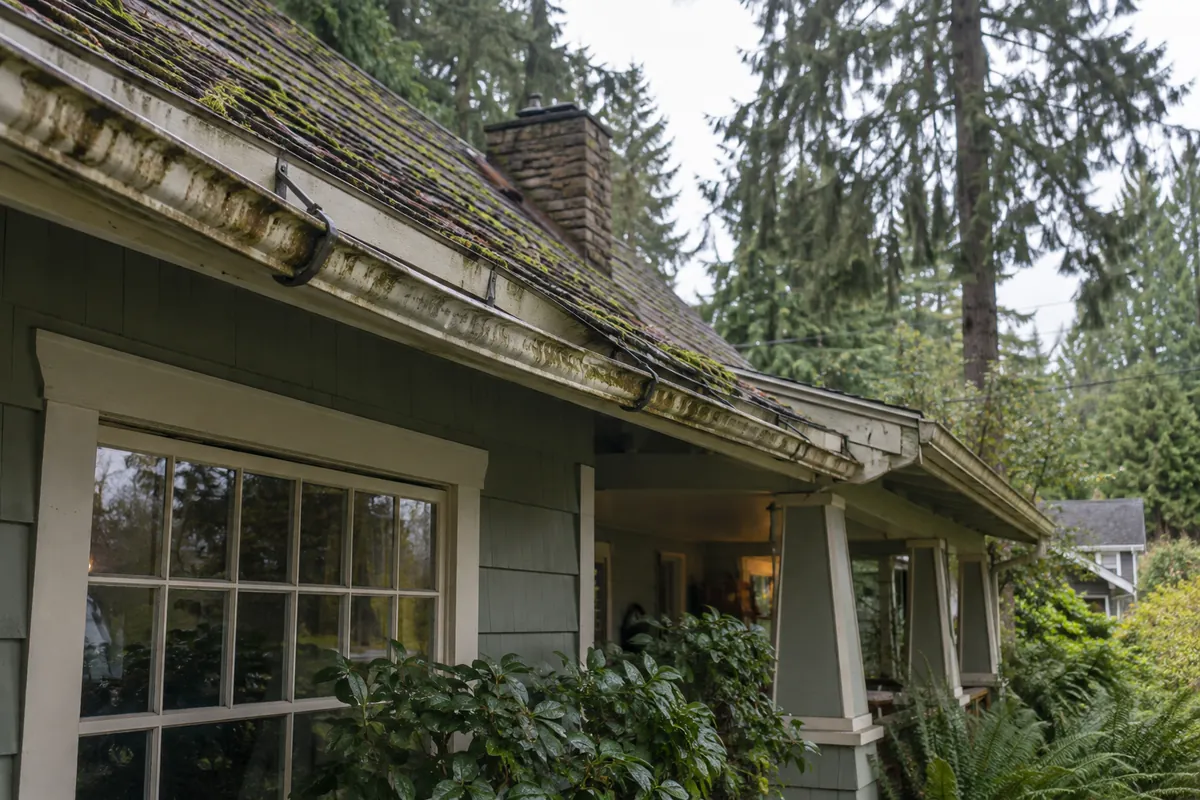
Gutters rarely fail all at once. They fail seam by seam: a drip behind the gutter here, a sagging run there, staining down the fascia, soil trenched out below the eaves. Once several sections show trouble — or the system is a sectional type from decades past — each repair buys less time than the one before it.
- Separated seams or corners that reopen after sealing
- Sagging runs, pulled hangers, or fascia rot behind the gutter
- Overflow in heavy rain even when the trough is clean
- Undersized 4-inch or early 5-inch profiles on a large roofline
- Rust-through on older galvanized steel systems
Many Edmonds-area homes date to the 1960s and 70s, and a good share still drain through systems installed one or two roofs ago. Replacement is the moment to correct old shortcuts — undersized profiles, too-few downspouts, poor routing — not just renew the metal.
Sized, Pitched, and Routed for the Roofline
Every replacement starts with measurement, not assumptions. Roof area, pitch, valley count, and tree exposure determine profile size and downspout placement; the gutter is then run seamless on-site in one continuous length per fascia line.
- Seamless K-style in 5-inch or 6-inch — 6-inch carries roughly 40 percent more water for larger rooflines
- Dozens of factory colors matched to trim, or copper and half-round for premium homes
- Hidden hangers set to spacing that holds through wind and rain load
- Downspouts sized and routed to move water well clear of the foundation
- Old material hauled away; fascia inspected before the new run goes up
Typical Replacement Cost Ranges
| System | Typical installed range* |
|---|---|
| Seamless aluminum, single-story | $9–$14 per linear foot |
| Seamless aluminum, two-story / complex roofline | $12–$20 per linear foot |
| Half-round aluminum | $14–$24 per linear foot |
| Copper (K-style or half-round) | $40+ per linear foot |
*Typical market ranges for the Puget Sound area; the written on-site estimate is exact for the specific home. Height, access, and roofline complexity drive the spread.
One Estimate, In Writing, No Pressure
A technician measures the roofline and quotes the full replacement on the spot — free.
Call (425) 414-7150What the New System Can Be Made Of
.032 aluminum is the workhorse: heavier than the .027 gauge sold in economy installs, rust-proof, and finished in dozens of baked-on colors that hold up against coastal air. It's the right answer for the large majority of homes, in K-style's familiar decorative profile.
Half-round aluminum trades a little capacity for the traditional curved silhouette that suits the Bowl's character homes and Tudor or Mediterranean architecture — and its smooth trough sheds debris more readily than angular profiles.
Copper is the fifty-year decision: soldered joints instead of sealant, zero repainting, salt-air immunity, and a patina that reads as craftsmanship on view and waterfront homes. Galvanized steel, common on mid-century homes, is generally replaced rather than matched today — modern aluminum outperforms it at lower cost, without the rust clock.
Profile size is specified per roofline, not per fashion: 5-inch K-style covers most single-story homes, while larger rooflines, steep pitches, and long runs get 6-inch troughs with 3x4 downspouts — roughly 40 percent more capacity for the November storm that finds every undersized system.
What a Written Replacement Quote Should Spell Out
A measured, written estimate protects both sides. Before any work is booked, the quote for a replacement should name every one of these items — and the free on-site assessment here always does:
- Exact linear footage per run, profile size, and material with color selection
- Downspout count, sizes, and placement — with routing shown, not implied
- Tear-off, haul-away, and recycling of the old system
- Fascia condition notes, flagged before installation rather than discovered after
- Hanger type and spacing (hidden hangers, load-rated intervals)
- Guard integration pricing, if wanted, while the crew is already on the roofline
- Total price and timeline in writing
Vague per-job quotes that skip footage and downspout counts leave room for surprises. Line items don't.
Often Paired With Replacement
Gutter Guards
The smartest moment to add micro-mesh protection is while the new system goes up — one visit, one ladder setup.
Gutter guards →Copper & Half-Round
For waterfront and estate homes, replacement is the natural time to step up to a 50-year material.
Copper & half-round →Seamless Installation
New construction and additions get the same on-site fabrication and sizing discipline.
Seamless installation →Frequently Asked Questions
How long does gutter replacement take?
Most single-family homes are completed in one day. Larger rooflines with complex valleys or copper work may take two. The crew fabricates the gutter on-site, so there is no waiting on pre-cut sections.
Is it worth replacing gutters before the rainy season?
Yes. The dry months from late spring to early fall are the ideal install window, and the system is then proven before the October-through-March stretch that delivers most of the area's annual rain.
Can new gutters be fitted with guards at the same time?
That is the most cost-effective time to do it. The crew is already on the roofline, and micro-mesh guards integrate cleanly with a new seamless run.
Do you replace fascia boards too?
Fascia condition is checked before installation. Minor rot discovered behind an old gutter is flagged and discussed before the new system goes up, so the mounting surface is sound.
Should gutters be replaced before or after a new roof?
After, ideally — roofing work is hard on gutters, and the drip edge needs to lap correctly over the new gutter's back edge. If both projects are coming, sequence the roof first and the gutters immediately behind it.
What happens to the old gutters?
They're torn off, hauled away, and recycled — aluminum and copper both have real scrap value, and none of it belongs in the flower beds or the landfill.
How disruptive is installation day?
Minimally. The crew works from ladders outside, fabrication happens at the truck, and there's no need for anyone to be home beyond a walkthrough at the end. Most single-family homes are done between morning and late afternoon.